When an international research agency or a global brand decides to run qualitative fieldwork in Italy — a packaging redesign test, a concept evaluation, a product validation, the exploration of a new consumer segment — the focus group is still the instrument that delivers the richest insight. It remains irreplaceable whenever what you need is not scale but motivation, language, spontaneous reaction, and the social dynamics that form around a product or a message. And yet the difference between a focus group that produces usable insight and one that generates only a transcript to archive is decided almost entirely outside the methodology, on the ground of the physical and technical infrastructure where the session takes place.
A discussion room is not a meeting room
The first mistake we frequently see from teams organising qualitative research on their own is treating a focus group like a structured meeting. A hotel conference room is booked, chairs are arranged around a table, a recorder is switched on, and the session begins. The outcome is almost always disappointing: participants stay formal, the moderator struggles to manage pacing, the client who observes the session unconsciously influences responses, and during post-production half of the non-verbal reactions turn out to be missing from the footage.
A room designed for focus groups is built on a different premise: everything in the space — lighting, acoustics, furniture layout, the position of the table relative to the reflective wall — is there to produce authentic behaviour and to make it fully documentable. A 21-square-metre room purpose-built for this task is not interchangeable with a 60-square-metre generic room, in the same way that an audio post-production suite is not interchangeable with a larger but unspecialised studio.
One-way mirror and viewing room: why they still matter
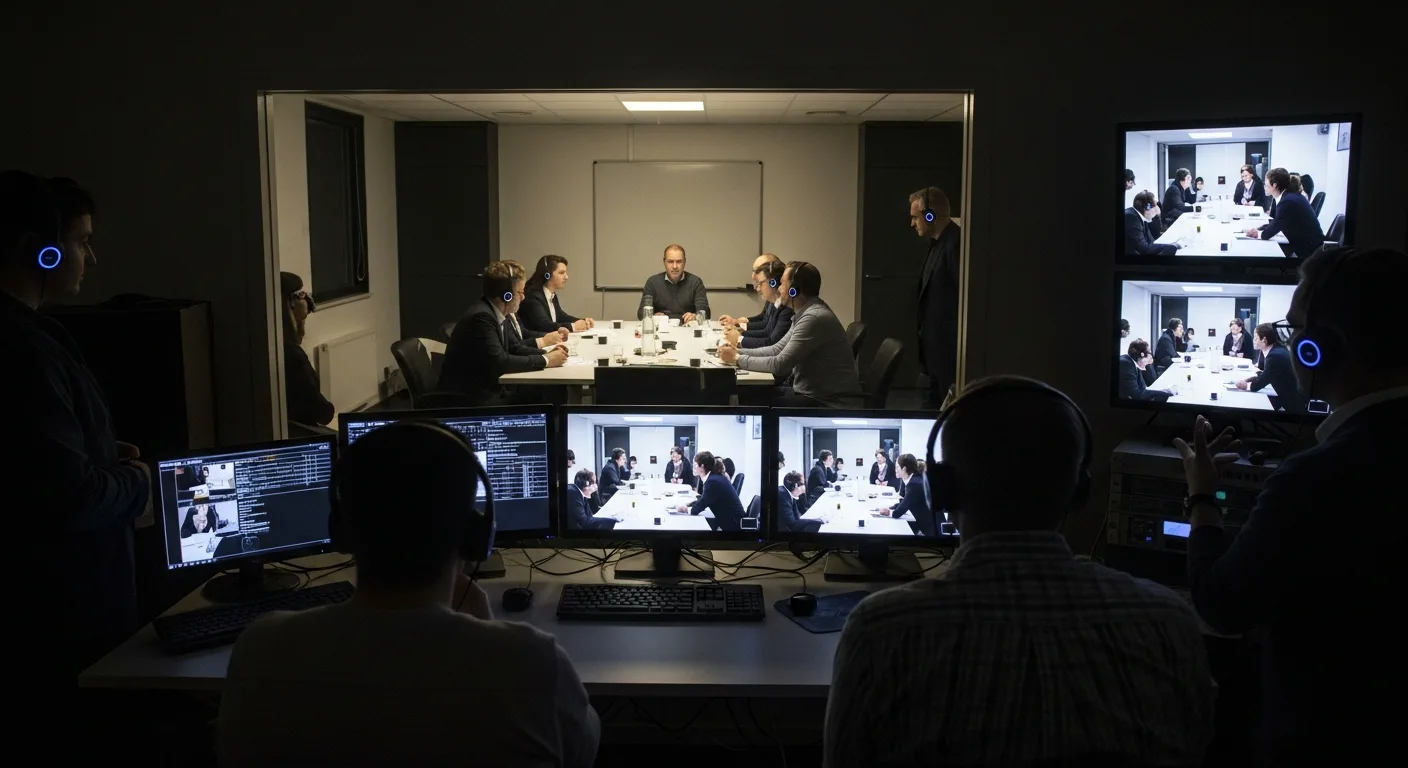
In a streaming-first era one could think the one-way mirror is a relic. It is the opposite. The reason clients who fund the research still prefer live observation behind the mirror rather than over video is neurological before it is technological: direct observation, with full visibility of participants' bodies and full audibility of the room, produces a level of understanding that no stream can replicate. The viewing room next to the mirror — with headphones, monitors, workstations for notes — is where the client constructs a real-time reading of the session, often together with the creative agency or the product team.
The dual-space layout, discussion room plus viewing room, also has a precise methodological function: it decouples the moderator's role from the client's. The moderator works with participants without hearing client comments, reactions or phone calls. The client comments freely without interfering. Both sides do their job better. In a single-room setup with videoconferencing, this decoupling is far more fragile.
The panel: the real invisible infrastructure
Room and technology are worth little if the participants are not the right ones. Recruitment is the bottleneck of any qualitative project, and it is the main reason why companies that attempt to organise focus groups internally run into inconsistent results. Finding eight to ten people with precise profiling characteristics, available in the same time window, correctly screened to exclude professional respondents, with incentives managed compliantly and no-shows kept below ten percent, requires a structured panel and an operational process that cannot be improvised.
For international agencies this is the single most critical element. A foreign research team landing in Rome has no way to vet Italian recruiters, cross-check respondent histories, or verify sample representativeness within the timeframe of a project. A professional facility offers this invisible layer: a proprietary panel, a screening system, incentive management, and exposure controls to prevent the same respondent from appearing in multiple studies. It is the component that more than any other separates an improvised operation from research that can be presented to the board with confidence that the target has actually been represented.
Streaming, simultaneous translation, recording: the technology layer
The technology layer of a modern facility has become standardised, which is exactly why it goes unnoticed — but it carries enormous weight on the quality of the deliverable. A stable 1 Gbps fibre connection enables live streaming to remote stakeholders without degradation, with everything this means for international agencies that need to involve teams distributed across multiple countries. A simultaneous translation booth makes multi-country projects viable without replicating the session in a second language. Multi-track audio-video recording, with ambient microphones and cameras on the table, produces clean material for the insight video clips that are now an integral part of modern research reports.
On these technical elements the gap between a purpose-built facility and a retrofitted meeting room is almost total. Attempting simultaneous translation, stable streaming and multi-camera recording in a non-specialised space is possible only at setup and rental costs that make the operation uneconomical.
Why Rome is a strategic base for qualitative research in Italy
Rome is the natural catchment for Italian qualitative research whenever representativeness matters. The metropolitan area holds over four million inhabitants and covers a demographic and socioeconomic stratification that Milan, however denser in purchasing power, does not offer. For consumer research on generalist targets, for B2B projects reaching decision makers across different company sizes, for cultural studies or mass-market categories, Rome provides a more varied panel.
International accessibility adds to this. For agencies and brands organising multi-country fieldwork with arrivals from London, Paris, Amsterdam, Frankfurt or the United States, Rome is reachable with frequent direct connections from every major European hub. A facility located outside the restricted traffic zone (ZTL) but close to metro and rail stations substantially reduces logistical friction for both the client team and the recruited respondents.
Roma Focus Lab: our choice to operate a dedicated facility
In this landscape we chose to operate a proprietary facility: Roma Focus Lab, a 460-square-metre venue in the Pigneto district, a few minutes on foot from the metro, outside the ZTL, with an internal garage and a partner hotel one hundred metres away. The facility is operated by Mebius srl, the same company that runs our mystery shopping and market intelligence services, and the integration between the two worlds has precise operational implications for international clients.
The layout spans fourteen rooms on a single floor, configurable by session type: three rooms with one-way mirrors, three viewing rooms, interview suites for in-depth one-on-ones, larger rooms accommodating up to thirty people for workshops and training, and a dedicated kitchen for product tests and sensory research. Staff is on site from 9:00 to 18:30 with extensions available on request, and the support services — recruitment through a proprietary panel, live streaming, simultaneous translation, catering from a partner 300 metres away, special rates at the 140-room hotel next door — cover the entire qualitative fieldwork cycle.
For international research companies working with us, the integration between mystery shopping, Voice of Customer analytics, and qualitative facility research is a non-trivial advantage: a customer experience measurement programme that gathers mystery observation in the field can find, in a focus group session, the explanation for the behaviours that were recorded, with full methodological continuity because the same team designs both phases.
If you are planning qualitative research in Italy and want to evaluate whether a dedicated facility fits your project, you can request the full brochure or a tailored quote directly from romafocuslab.com, or contact us through MysteryClient.it for an integrated proposal covering facility, recruitment, and complementary research services.
To learn more, you can read about how we joined ESOMAR earlier this year, or see our existing facility overview for the operational detail of our Rome venue.